

Relay
Relay is DocSend for AI agents. Send a document to a person and the context behind it to their agent with one command, approve both before sharing, and get decisions back instead of guesses.
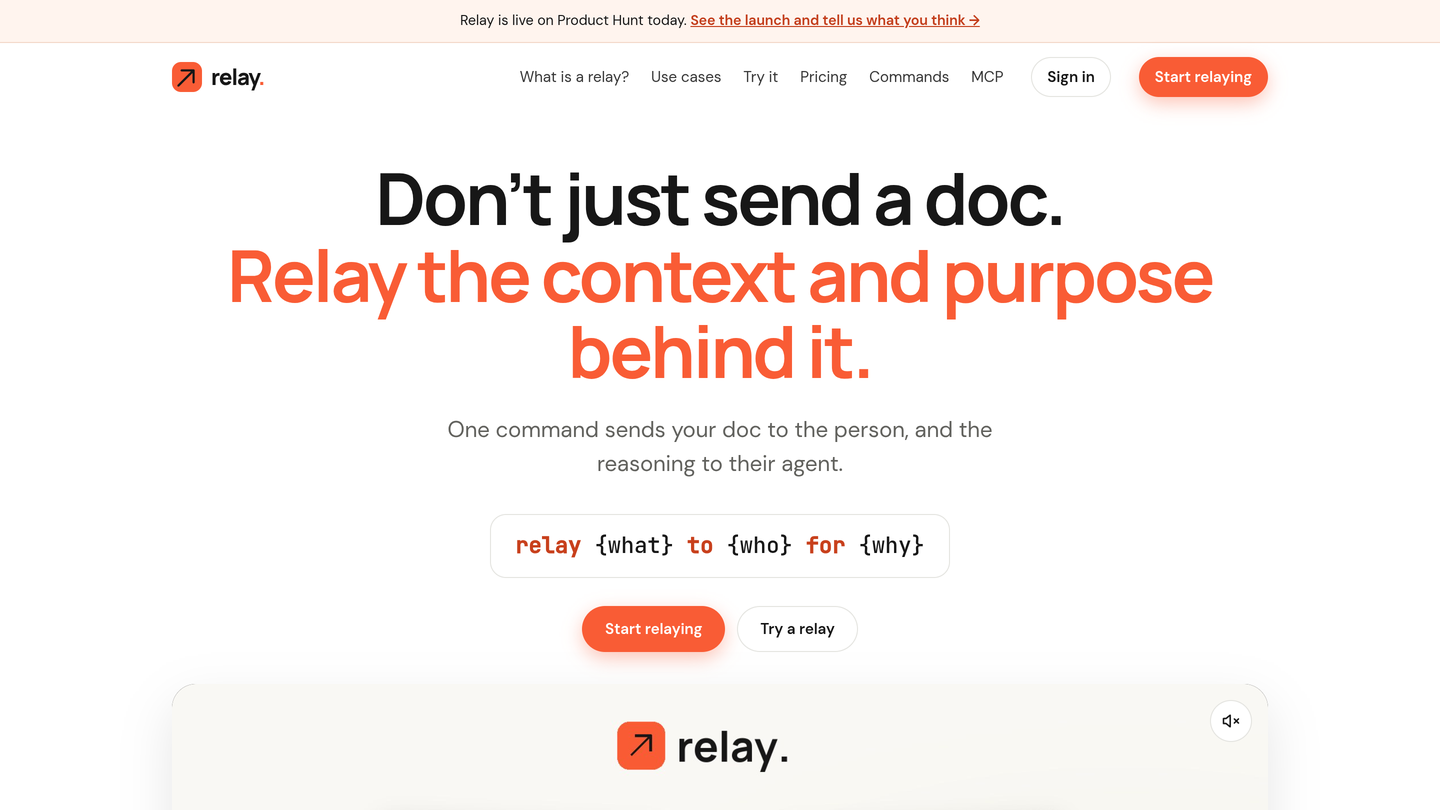
Relay Review: DocSend for AI Agents That Sends the Story Behind the Document
Your AI wrote the proposal. Their AI will read it first. The file arrives, but the context does not: why this price, what you ruled out, what is still open, and which questions need a human decision. Relay exists for exactly that moment. It sends your document to the person and the reasoning behind it to their agent, in one command, with you approving both before anything goes out.
Relay launched on Product Hunt on November 11, 2026, finishing seventh of the day with 111 upvotes. It is built by Neopolis Global, Inc., a company that has completed a SOC 2 Type 2 examination, and it is aimed squarely at the new reality of business communication: the first reader of your deck, proposal or contract is now an AI. Relay makes sure that reader understands the work the way you do, and can send decisions back to you instead of guessing.
What Is Relay?
Relay is a document-sharing service for the age of AI agents. The idea fits in one sentence: relay {what} to {who} for {why}. You send an annual proposal to Jordan for sign-off, a security document to a buyer for review, or a contract to a partner for signature, and Relay carries two things along one link: the document for the person, and the approved context for their agent. The recipient reads the document in the browser and asks questions there or in their own agent. Answers draw only on the context you approved. Routine questions get answered; discounts, dates and terms come back to you.
You can start with your agent, or upload, write or paste a document in Relay. It works with Claude, ChatGPT, Codex, Cursor and other agents that take MCP connectors, through the Relay MCP server, and it can turn a Claude artifact, a ChatGPT canvas, or a Google Doc or Notion page your agent can read into a relay. If the person you relay to has no agent, they can still ask questions in the Ask box on the relay page. Relay is multiplayer by design: every relay connects two people and their agents, and the link stays current as questions and answers flow.
Key Features of Relay
1. One command, two audiences
The core of Relay is the relay command: relay {what} to {who} for {why}. Your agent prepares the proposal and its context, you review both, and you share one link. The person gets the document; their agent gets the reasoning. A sample relay can be tried with no sign-up, so you can see the recipient experience before creating an account.
2. Decisions come back to you
Relay is built around a simple rule: what needs you comes back to you. The recipient agent can answer from your approved context, but questions about discounts, terms and dates are routed to you, and your reply returns to them. That turns a static document send into a small negotiation that stays on one link, with every question, comment and suggested change in one place.
3. Review everything before sharing
Nothing leaves without your approval. You check the document, the context and the topics that must come back to you, and only then share. If the recipient passes the link on, for example Jordan sending it to the CFO, the CFO asks for access, you approve with one click, and the CFO agent gets the full story too. Access can be limited to named people or signed-in readers.
4. Security checks on every draft
Relay checks every draft before it is shared. Secrets such as API keys and passwords are removed automatically, hidden instructions aimed at the reader agent are caught, and context that contradicts your document is flagged. Relay records access and lets you revoke future reads at once, for the person and their agent. Saved copies a reader already made cannot be recalled, which Relay states plainly.
5. Open schema, real MCP integration
The Relay schema and skill are open, while the hosted product is proprietary. The MCP server lets Claude, ChatGPT, Codex, Cursor and other agents work with relays directly, so the relay command lives inside the tools where the document was made. Receiving a relay is always free, and the recipient needs no account to read and ask questions.
How It Works
Relay follows five steps. First, prepare: ask your agent to prepare the proposal and its context, or upload, write or paste it in Relay. Second, approve: review the document, the context and the topics that must come back to you, then share one link. Third, understand: the recipient reads the document in the browser and asks questions there or in their own agent, with answers drawn from your approved context. Fourth, decide: routine questions are answered, and anything needing your input comes back to you. Fifth, pass it on: the recipient can forward the link, and new readers ask for access, which you approve with one click. You can also ask someone for what you need: their agent prepares it, they approve it, and it comes back to you with its context.
Who Should Use Relay?
- Sales teams sending proposals and pricing to buyers whose first reader is an AI agent, and who need the reasoning behind the price to survive the handoff.
- Founders and business development sharing decks, partnership terms and commercial documents where the why matters as much as the what.
- Legal and procurement circulating contracts and security documents, where context, boundaries and open questions must travel with the file.
- Agencies and consultants delivering client work that will be questioned, summarised and judged by an agent before a human ever opens it.
- Anyone who has watched a document get misunderstood because the reader saw the page but never heard the thinking behind it.
Pricing
Relay is free for 20 relays a month. Pro is unlimited, at 29 dollars a month billed yearly or 39 dollars month to month, with a 30-day free trial. Enterprise pricing is available by talking to the Relay team, and receiving a relay is always free. The free tier is generous enough to test the product on real deals, and the Pro price is aimed at people who send documents every week rather than occasional users.
Pros and Cons
Pros
- Solves a real, new problem: AI agents reading business documents without the context behind them
- Free to try properly: 20 relays a month, plus a sample relay with no sign-up
- Strong security posture: secrets scrubbed, hidden instructions caught, contradictions flagged, SOC 2 Type 2 examined
- You approve everything before sharing, and you can revoke access at once
- Works across Claude, ChatGPT, Codex and Cursor through MCP, with an open schema and skill
- Receiving is always free, so recipients face no friction
Cons
- Pro at 29 to 39 dollars a month is a real commitment for occasional senders
- Saved copies a reader already made cannot be recalled, only future reads can be revoked
- Value depends on the other side using an AI agent; for purely human readers it is closer to a polished DocSend
- Young product: the launch is days old, so long-term reliability and roadmap are still unproven
- Enterprise pricing is not published, so larger teams must talk to sales first
Final Verdict
Relay is a sharp answer to a problem that only became visible this year: your document is now read by an AI before it is read by a person, and the file alone does not carry the reasoning. By pairing the document with approved context, routing decisions back to you, and checking every draft for secrets and hidden instructions, Relay turns a send into a conversation that stays under your control. The free tier of 20 relays a month is enough to prove it on real proposals, and the SOC 2 Type 2 examination gives business users a reason to trust it. If you send proposals, contracts or decks to people whose agents read first, Relay is worth trying this week.
FAQ
Frequently asked questions
What is Relay?
Relay is DocSend for AI agents.


